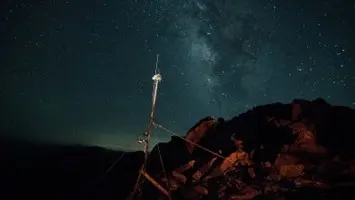
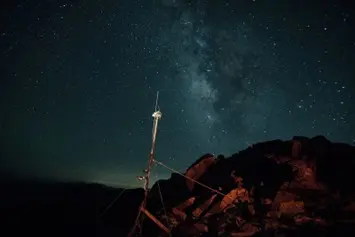
Former WMRC researcher Dr. Stephanie Wissel was recently awarded a 14-million-euro European Research Council Synergy Grant to continue her work on neutrino particles. She is currently an associate professor of physics and of astronomy and astrophysics in the Penn State Eberly College of Science.
The grant funds a project titled “Opening a new window on the violent Universe with the Hybrid Elevated Radio Observatory for Neutrinos (HERON).” A portion of the project will also be funded by Penn State to build a new observatory in a mountainous area in the San Juan province in Argentina. Along with a telescope, a new phased array, and a standalone array will be installed to communicate with the telescope as it works to detect these elusive particles. These high-energy subatomic particles have been dubbed “Ghost Particles,” since they are hard to detect, being that they rarely interact with matter and can pass through violent events like stellar explosions.
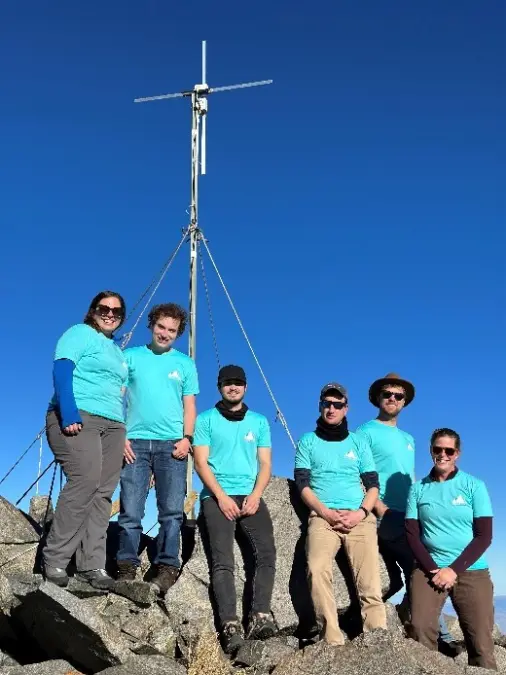
The equipment used is highly sensitive and has its origins in the White Mountains of California. Over seven seasons at WMRC, Stephanie and her team demonstrated that the phased array they deployed could detect cosmic rays, which are more prevalent than neutrinos.
Stephanie began her research in 2018 while at Cal Poly San Luis Obispo and has collaborated with other researchers from the University of Chicago, JPL, UCLA, Kansas University, Ohio State, and Santiago de Compostela.
To learn more about the BEACON project, visit our YouTube channel.
Tags: Astrophysics, Barcroft Station, Research